
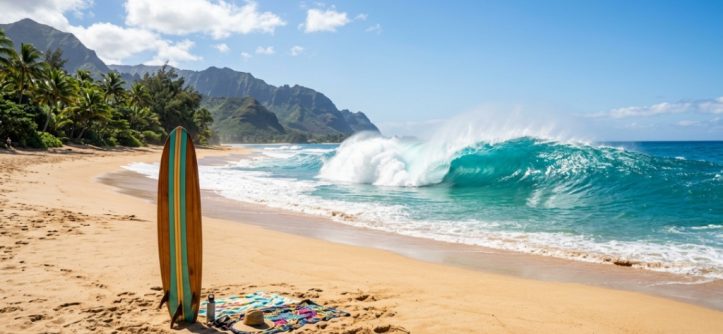
Hawaiian surfers measure waves from the back—meaning a “4-foot Hawaiian” wave has a 6–8-foot face that hits with twice the force of a same-size mainland wave, and your surfboard size must account for this power differential, or you’ll spend more time getting worked than actually surfing. Picking the right surfboard size for Hawaii island conditions requires understanding that length, width, thickness, and volume all interact differently in Hawaiian wave energy compared to less powerful breaks. A surfboard’s “size” encompasses four dimensions: length (nose to tail), width (widest point rail to rail), thickness (thickest point deck to bottom), and total volume (measured in liters)—each affecting how the board performs in terms of paddle speed, stability, wave-catching ability, and maneuverability. The sizing mistake most Hawaii visitors make? Using mainland formulas. The surfboard size guide that worked for California or East Coast beach breaks underestimates what Hawaiian reef waves demand from your equipment. This guide provides Hawaii-specific sizing that accounts for the ocean’s real power here—not theoretical calculations from calmer waters.
Why Does Standard Surfboard Sizing Fail in Hawaii?
Standard sizing fails because it assumes average wave power—while Hawaiian waves deliver 2–3x more energy at equivalent heights due to long-period open-ocean swells hitting shallow reef, requiring more board volume, length, and rocker than same-height waves elsewhere demand.
The physics behind Hawaii’s sizing requirements:
- Swell period difference: Mainland beach breaks commonly receive 8–12 second swell periods. Hawaii regularly receives 14–20+ second periods. Longer period = exponentially more water movement = more force pushing your board. A 4-foot wave at 16 seconds carries roughly 4x the energy of a 4-foot wave at 8 seconds.
- Reef acceleration: Hawaii’s waves break over a hallow coral reef, which causes abrupt water depth changes. Deep water (50+ feet) meets reef shelf (3–8 feet) over a short distance—creating rapid wave steepening that launches boards faster and with more force than gradually sloping sand bottoms.
- Current intensity: Hawaiian channels and reefs create powerful currents that a surfer must paddle against to reach the lineup. More volume means more flotation, which means more efficient paddling against currents—reducing exhaustion before you even catch your first wave.
- Take-off speed: Hawaii’s reef waves break faster than beach breaks. You need to be moving at wave speed sooner—requiring a board with enough length and volume to generate paddle speed quickly,y rather than the gradual acceleration that longer, slower beach breaks allow.
Practical rule: add 3–7 liters of volume beyond what standard mainland sizing charts recommend for your weight and ability level. This Hawaii adjustment accounts for power, current, and take-off speed differences without overboarding you.
How Do You Calculate Your Ideal Volume for Hawaiian Waves?
Calculate your ideal Hawaii surfboard volume by multiplying your body weight in kilograms by a skill-level multiplier, then adding 3–5 liters for Hawaii’s power factor—landing on a volume that provides paddle efficiency and wave-catching ability matched to island conditions.
Hawaii volume formula:
| Skill Level | Base Multiplier (Weight in kg × multiplier) | Hawaii Addition | Example (75 kg/165 lb surfer) |
|---|---|---|---|
| Beginner | × 0.9 – 1.1 | +5–7 liters | 67–82 + 5–7 = 72–89 liters |
| Intermediate | × 0.5 – 0.7 | +3–5 liters | 37–52 + 3–5 = 40–57 liters |
| Advanced Intermediate | × 0.38 – 0.48 | +2–4 liters | 28–36 + 2–4 = 30–40 liters |
| Advanced/Pro | × 0.32 – 0.38 | +0–3 liters | 24–28 + 0–3 = 24–31 liters |
Important nuances:
- These ranges assume standard fitness levels. Surfers with strong paddling ability (swimmers, paddlers, gym-conditioned) can use lower range values.
- Surfers over 40 or with average fitness should lean toward upper range values—paddle endurance decreases with age, and additional volume compensates.
- The Hawaii addition decreases as skill increases because advanced surfers can generate paddle speed through technique rather than relying purely on board volume.
- For small wave days (under 3 feet), add 5–8 liters to any calculation—small Hawaiian days still move fast, and volume prevents frustrating flat-spell sessions.
What Length Surfboard Do You Need for Different Hawaiian Breaks?
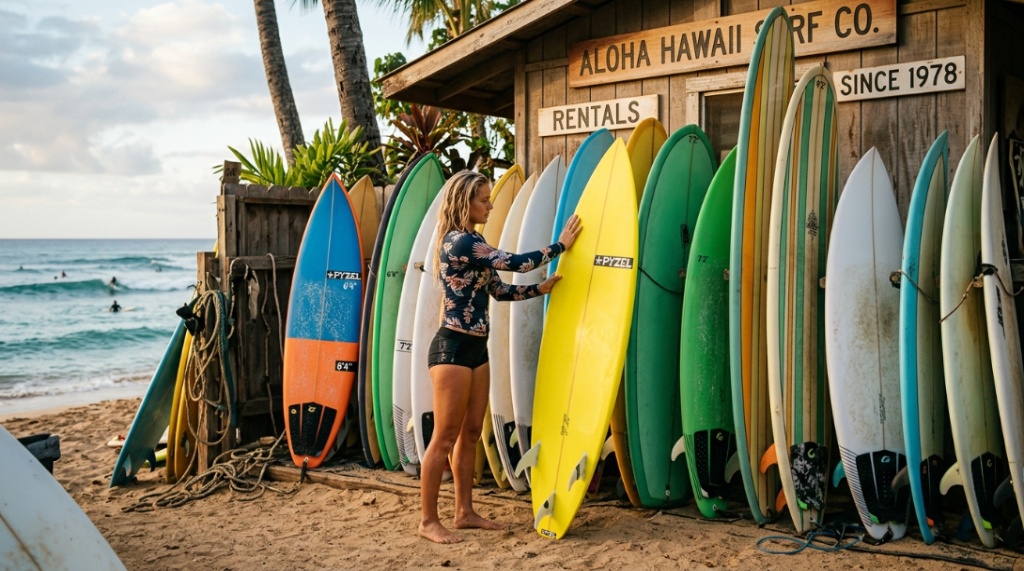
Board length in Hawaii ranges from 5’6″ for expert shortboarding in hollow waves to 9’6″+ for longboarding at Waikiki, with most recreational surfers finding their sweet spot between 6’6″ and 8’0″ depending on skill level and primary wave type.
Length recommendations by Hawaii wave type:
- Waikiki/gentle south shore rollers: 8’0″–9’6″. Long, slow-breaking waves reward board length that maintains glide through flat sections. Classic longboard territory—or minimum 8′ foam boards for beginners.
- Town breaks (Ala Moana to Diamond Head): 6’4″–7’6″. Medium-power waves that allow turns but reward some length for paddle positioning. Funboards and fish shapes thrive here.
- North Shore moderate days (4–6 feet): 6’0″–6’8″ for advanced surfers, 7’0″–8’0″ for intermediates. Power requires paddle speed—don’t go too short unless your paddle fitness is excellent.
- North Shore solid (6–10 feet): 6’6″–7’6″ step-up shapes. Extra length provides the entry speed needed for drops on steep, fast-breaking faces. Length = survival in bigger Hawaiian surf.
- Big wave (10+ feet): 7’6″–10’+ gun shapes. Length is your paddle-in speed tool—longer boards reach wave speed faster for critical late drops on massive faces.
Length affects performance in three primary ways in Hawaiian surf:
- Paddle speed: Longer boards paddle faster. In Hawaii, where you’re fighting currents and need a quick wave-catching response, inadequate length means missed waves and exhaustion.
- Stability at speed: Hawaiian waves generate high board speed. Longer boards track straighter and more predictably at speed—shorter boards can become twitchy and unpredictable when Hawaii’s power accelerates them beyond control.
- Maneuverability trade-off: Every inch of length reduces turning response. Balance your need for paddle speed/stability against your ability to perform turns—don’t sacrifice wave-catching for maneuverability you can’t yet execute.
How Does Surfboard Width Affect Performance in Hawaii?
Width determines stability and paddle efficiency—wider boards (20″+) provide more stability for beginners and better small-wave performance, while narrower boards (18″–19.5″) offer rail-to-rail speed for advanced turns in powerful Hawaiian surf.
Width selection guide:
- 22″–23″ (wide): Maximum stability. Excellent for beginners, longboards, and small-wave cruising. Harder to transition rail-to-rail quickly, which limits advanced turning but provides confidence for developing surfers.
- 20″–21.5″ (moderate): Balance point for most intermediate and advanced intermediate surfers. Enough stability for comfortable paddling, narrow enough for progressive rail work. Most funboards and fish shapes sit in this range.
- 18.5″–19.75″ (narrow): Performance width for advanced surfers. Allows rapid rail-to-rail transitions for vertical turns in powerful waves. Requires strong balance and paddle fitness—unstable for surfers without daily water time.
- Under 18.5″ (very narrow): Specialized performance boards for pro-level surfing in powerful hollow waves. Impractical for anyone outside the top 5% of surfers globally.
Hawaii-specific width consideration:Widerr boards handle the bump and chop of Hawaiian trade wind swell better than narrow boards. If you’re surfing in cross-shore winds (common on south shore afternoons and north shore mornings), an extra 0.25″–0.5″ of width adds stability through textured water that narrow boards struggle with.
How important is the rocker for Hawaiian Waves?
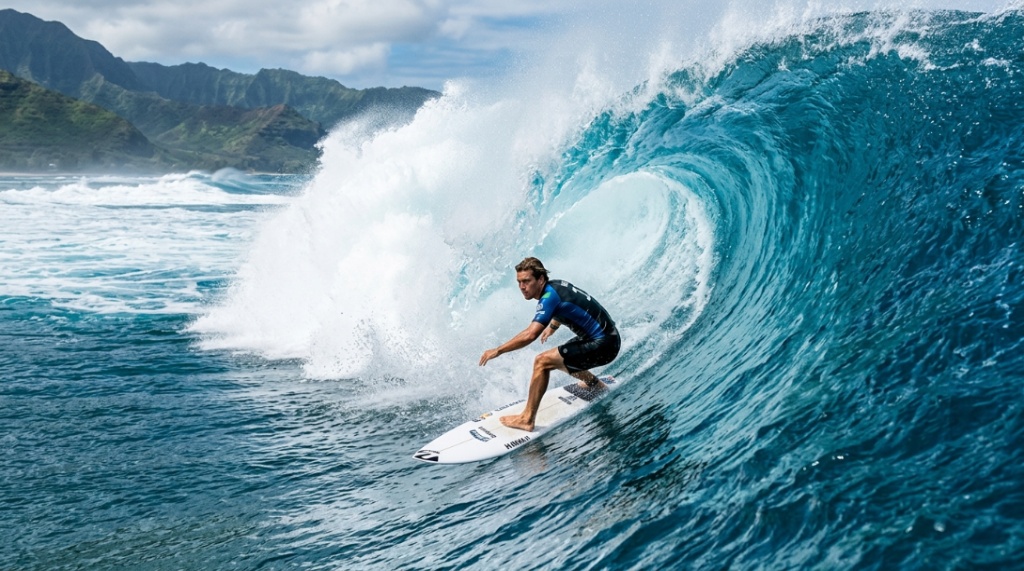
Rocker is critically important in Hawaii—more rocker (nose and tail curve) prevents nosediving on steep drops and allows tighter turns in powerful wave pockets, while less rocker maintains speed in weaker sections and improves paddle efficiency.
Rocker explained for Hawaii conditions:
- More nose rocker: Prevents the nose from catching water (pearling/nosediving) during steep take-offs. Hawaiian reef breaks create steep, fast drops where low nose rocker guarantees pearling. Essential for any wave with a late, steep take-off (Pipeline, Backdoor, Sunset).
- More tail rocker: Allows tighter turns by releasing water from under the tail during directional changes. Important for powerful waves where you need to redirect quickly in the pocket. Also prevents tail catching on steep wave faces during bottom turns.
- Less overall rocker: Faster paddling and more glide in flat sections. Important for small-wave boards and longboards, where speed generation is more critical than steep-drop survival. Appropriate for Waikiki-style gentle rollers.
The Hawaii rocker rule: boards designed for steeper, more powerful waves need progressively more rocker. A Waikiki longboard can be flat-rockered for maximum glide. A Pipe shortboard needs significant nose and tail kick to handle the near-vertical drops and tight pocket surfing that hollow waves demand. When in doubt for Hawaii, err toward slightly more rocker than less—a bit more rocker costs some flat-section speed but prevents the nosedives that can injure you on steep reef breaks.
What Thickness Do You Need for Hawaiian Surfing?
Thickness adds volume without dramatically affecting outline shape—most Hawaiian surfers need 2.25″–2.75″ for shortboards, 2.5″–3″ for funboards, and 3″+ for longboards, with thicker boards providing more float and paddle power for Hawaii’s demanding paddle-outs.
Thickness considerations specific to Hawaii:
- Paddle-out demands: Extra thickness = extra flotation = less energy expended reaching the lineup. Hawaii’s currents make paddle-outs genuinely exhausting—even 0.125″ extra thickness adds measurable flotation that reduces paddle fatigue over a session.
- Duck diving trade-off: Thicker boards are harder to push underwater when duck diving through breaking waves. If you’re surfing spots with heavy paddle-through zones (Sunset, Laniakea), a too-thick board makes getting out back nearly impossible on big days.
- Speed in critical sections: Thin rails (achieved through lower thickness toward the rail edges) allow boards to cut into the wave face sharply—critical for high-performance surfing in Hawaii’s hollow waves. Too much overall thickness can prevent rail engagement in powerful, steep pockets.
Choosing the right board is only half the battle when taking on powerful island breaks; your gear needs to hold up to the ocean’s energy, too. To stay confident and secure in heavy swells, it is equally important to invest in high-performance surfing swimsuits without compromising quality. Having durable swimwear ensures you can focus entirely on your stance and wave selection without any distracting wardrobe malfunctions.
Balance point: add thickness through the center stringer area (under your chest during paddling) while keeping rail thickness moderate. This provides paddle flotation without sacrificing the rail engagement needed for performance surfing. Many Hawaii shapers achieve this through deck dome and belly contours rather than uniform thickness increases.
Conclusion
Surfboard sizing for Hawaiian waves demands Hawaii-specific adjustment that mainland experience alone doesn’t provide. The island’s powerful swells, reef acceleration, strong currents, and fast-breaking waves all push toward slightly more volume, length, and rocker than equivalent-height waves elsewhere require. Calculate your base volume, add the Hawaii factor (3–7 liters depending on skill), select a length matched to your primary wave type, choose a width appropriate for your rail work ability, ensure adequate rocker for steep drops, and distribute thickness for paddle efficiency.
When uncertain between sizes, size up rather than down. An extra liter of volume costs you minimal performance but gains significant wave-catching and paddle endurance—the two factors that determine whether a Hawaii session delivers 15 waves or 5. Hawaii’s waves reward preparation and appropriate equipment. Size your board for the ocean’s reality, not your ego’s preference, and every session delivers maximum wave count and progression.
Frequently Asked Questions
Should I ride a bigger board in Hawaii than at home?
Generally yes—2–5 liters more volume and 2–4 inches more length than your standard mainland board. Hawaii’s wave power and paddle demands exceed most mainland conditions even at equivalent wave heights. The extra size compensates for more powerful currents, faster wave speed, and the energy required for Hawaiian paddle-outs. Size up for your first sessions and adjust downward only after you’ve calibrated to local conditions.
How does the Hawaiian wave measurement system affect board choice?
Hawaii measures waves from the back (roughly half the wave face height seen from shore). A “6-foot Hawaiian” wave has an 8–12-foot face. This matters for board selection: when locals recommend boards for “4–6 foot waves,” they mean waves with 6–10 foot faces. Always clarify whether sizing advice uses the Hawaiian scale or face measurement—the difference dramatically changes appropriate board dimensions.
What volume surfboard do I need for Waikiki?
For Waikiki’s gentle, rolling waves, beginners need 70–90+ liters (8–9-foot foam boards); intermediates need 45–65 liters (longboards or large mid-lengths); and advanced surfers typically ride 35–50 liters on classic longboards for style riding. Waikiki rewards volume and glide—you can’t have too much volume here. Even advanced surfers ride high-volume longboards at Waikiki for the pure fun of long, cruising rides.
Can a surfboard be too big for Hawaiian waves?
Yes—oversized boards become dangerous in powerful Hawaiian surf because they’re harder to control at high speeds, more difficult to duck dive through approaching sets, and can launch skyward during wipeouts (becoming a projectile hazard to yourself and others). Too-big boards also prevent you from performing the maneuvers needed to safely navigate powerful wave sections. Size appropriately—not excessively.
How do I size a step-up board for bigger Hawaii days?
A step-up is typically 4–8 inches longer, 0.25–0.5″ narrower, and slightly thinner-railed than your daily driver, with more nose and tail rocker for steeper drops. For Hawaii specifically, if your daily driver is 6’0″ × 19.25″ × 2.5″, a North Shore step-up might be 6’6″ × 19″ × 2.6″ with increased rocker throughout. Consult a local shaper who can dial exact dimensions for your target breaks.
Does water temperature in Hawaii affect board sizing?
Indirectly, Hawaii’s warm water (74–80°F) means you surf in boardshorts or a thin rash guard rather than thick wetsuits. Without wetsuit buoyancy adding flotation, your board must provide all your flotation independently. In cold-water regions, 4/3mm wetsuits add 2–4 liters of effective buoyancy, which Hawaii surfers don’t receive. Factor this into volume calculations if you’re coming from a cold-water surfing background where wetsuit buoyancy supplemented your board volume.




Leave a Reply