
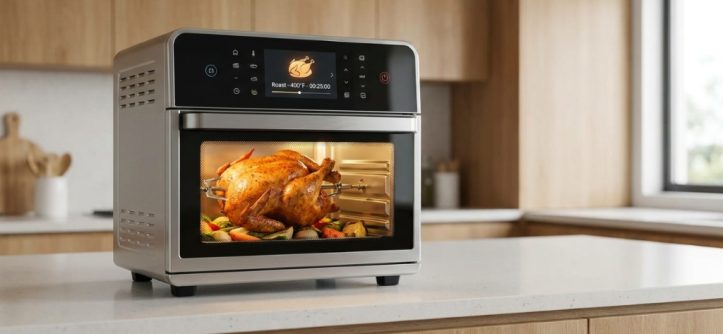
A family of four generates roughly 1,100 meals per year at home — and the oven handling those meals either saves your household 6+ hours weekly through smart automation or steals that time through outdated manual cooking that demands constant attention. Choosing a smart air fryer oven sized for family cooking means selecting a unit with enough capacity to prepare a full meal in one cycle rather than forcing multiple batches that double cooking time and energy consumption. A family-size smart air fryer oven is a countertop convection cooking appliance with 26–32+ quart capacity, WiFi-connected controls, and intelligent cooking programs — large enough to roast a 5-lb chicken, cook a full sheet pan of vegetables, or air fry enough wings for four hungry people simultaneously. The costly mistake families make? Buying a compact “personal size” air fryer that handles two servings at most — then running it three consecutive times to feed everyone, negating the time and energy savings the appliance was supposed to deliver. This guide identifies the exact capacity, features, and performance specs a family-size air fryer oven needs to genuinely serve a household of 3–6 people in single cooking cycles.
What Size Air Fryer Oven Does a Family Actually Need?
A family of 3–4 needs a minimum 26-quart capacity air fryer oven, while families of 5–6 should look at 30–32+ quart models — ensuring full meals cook in one batch without overcrowding that reduces air circulation and produces soggy rather than crispy results.
Capacity-to-family-size guide:
| Family Size | Minimum Capacity | Ideal Capacity | What It Fits (Single Batch) |
|---|---|---|---|
| 2–3 people | 20 quarts | 24–26 quarts | 4 chicken breasts, half-sheet of fries, 9″ pizza |
| 3–4 people | 26 quarts | 28–30 quarts | Whole 5-lb chicken, full sheet pan veggies, 12″ pizza |
| 5–6 people | 30 quarts | 32+ quarts | 6-lb chicken, two racks simultaneously, 13″ pizza |
| 6+ or entertaining | 32 quarts | 36+ quarts | Turkey breast, two full sheet pans, family-size casserole |
Critical distinction: marketed “quart capacity” measures total interior volume — not usable cooking space. Racks, drip trays, and clearance requirements reduce effective cooking area by 20–30%. A “30-quart” oven provides approximately 21–24 quarts of actual food-holding space. Always check interior dimensions (width × depth × height) rather than trusting capacity claims alone.
The overcrowding problem: air fryer ovens work by circulating hot air around food surfaces. Overcrowding blocks airflow — converting air frying into steaming. Food packed tightly won’t crisp. For proper results, food should occupy no more than 70% of rack surface area with space between pieces for air circulation. Size up beyond minimum capacity to ensure this airflow margin exists.
What Features Matter Most for Family Cooking?
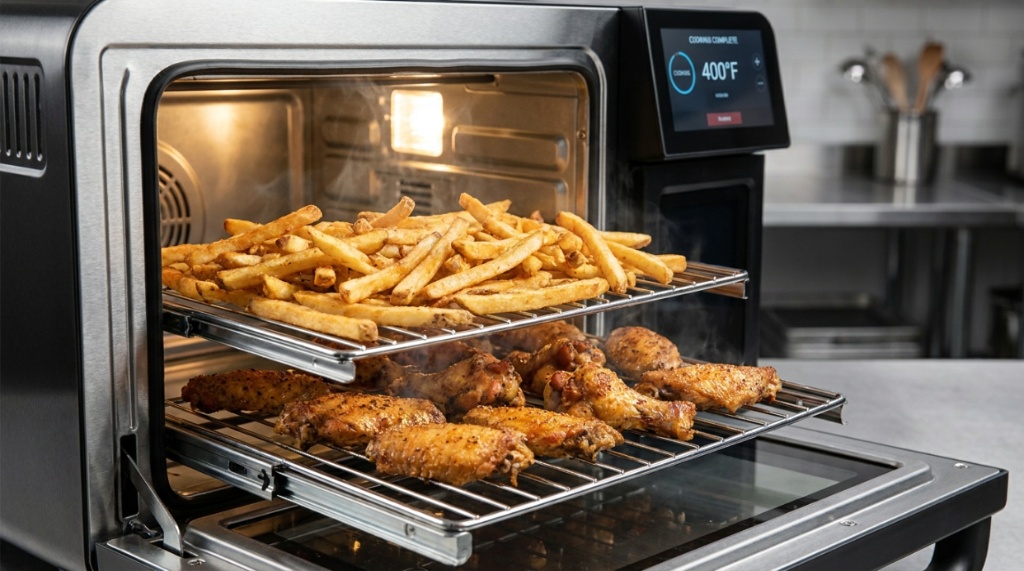
The features that matter most for family cooking are: dual-rack simultaneous cooking (different foods at different levels), a temperature probe for fool-proof protein, preset family meal programs, and a large enough door opening to insert and remove heavy, full-capacity dishes safely.
Family-priority feature breakdown:
- Dual-rack cooking (essential): Cook protein on one rack and vegetables on another simultaneously — completing an entire family meal in one cooking cycle. Without dual racks, you’re cooking sequentially: protein first, vegetables second, adding 15–20 minutes to every family dinner.
- Temperature probe (essential for families): Guarantees chicken reaches safe 165°F without overcooking to dry 185°F. Critical for families with children where food safety is non-negotiable but overcooking wastes expensive protein into inedible dryness. Set once, walk away, serve perfect protein every time.
- Rotisserie function (high value): A rotating spit that fits a 5-lb chicken produces the most evenly cooked, crispiest roast chicken possible — a family staple meal that takes zero attention once loaded. Rotisserie whole chickens feed families for multiple meals (dinner + next-day sandwiches/salads).
- Easy-clean interior (essential for daily use): Families cook daily — meaning daily cleanup. Non-stick interior coating, removable crumb trays, and dishwasher-safe racks reduce the 5–10 minutes of post-meal cleaning that makes daily air fryer use feel burdensome rather than convenient.
- Large door opening with stable hinges: Inserting a full sheet pan loaded with food for four requires wide door access and a door that stays open when needed. Small openings or spring-loaded doors that snap closed while you’re loading heavy food create burn risk and frustration.
- Timer with auto-shutoff + keep-warm: Family meals don’t always serve the moment cooking finishes. A keep-warm function (holds at 170°F) maintains food quality for 15–30 minutes while you gather the family, set the table, or finish other dishes. Auto-shutoff prevents overcooking if you’re distracted by children or household demands.
How Do You Evaluate Cooking Evenness for Family Portions?
Evaluate cooking evenness by checking user reviews specifically mentioning “full rack” or “full capacity” results — because many air fryer ovens perform well with small portions but develop hot spots and uneven browning when loaded to family-size capacity.
Evenness evaluation methods:
- Review mining technique: Search product reviews for terms like “uneven,” “rotate,” “one side,” “back burns.” If multiple reviewers mention rotating food mid-cook, the oven has heat distribution problems at capacity. Single-portion reviewers saying “perfect results” tells you nothing about family-load performance.
- Element configuration check: Ovens with multiple heating elements (top + bottom, or multiple zones) distribute heat more evenly than single-element designs. Look for “5-element,” “dual-heating,” or “Element IQ” terminology that indicates distributed heat engineering.
- Fan placement assessment: Rear-mounted convection fans push air from back to front — creating cooler zones near the door. Top-mounted fans push air downward more evenly across the full rack. Side-mounted fans (rare, premium) create the most uniform circulation. Fan placement affects front-to-back evenness across full racks.
- Rack position testing (after purchase): Cook a full sheet of bread slices (the classic “toast test”). Even browning across all positions indicates good distribution. Dark corners or pale center zones indicate where your oven over- or under-heats — informing how you position food going forward.
Brands with strongest family-load evenness reviews: Breville (Element IQ adjusts individually), Ninja (TrueSurround convection), and Cuisinart (even heating specifically mentioned in large-format models). Budget models from lesser-known brands frequently show evenness complaints at full capacity in user reviews.
What’s the Best Smart Air Fryer Oven Size for Different Family Meals?
Common family meals require specific interior dimensions — verify that your target oven accommodates a 12″ pizza, a 9×13″ baking dish, and at minimum four chicken breasts on a single rack with circulation space between them.
Meal-to-dimension matching:
- Family pizza night (12–13″ pizza): Interior width must exceed 13 inches. Many “large” air fryer ovens have 12.5″ interior width — barely fitting a 12″ pizza with no clearance. Verify actual interior width measurements, not external dimensions.
- Casserole/baking (9×13″ dish): Interior must accommodate 9×13″ Pyrex or ceramic dish with space around edges for air circulation. Many 26-quart ovens fit this dish; some 24-quart models do not.
- Whole chicken (4–6 lbs): Interior height must exceed 7 inches for rotisserie spit clearance, or 6 inches for rack-roasting. Verify height specifically — wide/deep ovens can still be too short for upright poultry.
- Sheet pan meals (full family): The oven’s included baking pan should measure at minimum 11×15 inches (half-sheet equivalent). Standard quarter-sheet pans (9×13″) are minimum for 4-person family meals.
- Batch baking (cookies, muffins): Dual-rack capability lets you bake two trays of cookies simultaneously. Verify rack spacing allows standard muffin pan or cookie sheet with adequate clearance on both levels.
How Much Should a Family Invest in a Smart Air Fryer Oven?
Families should invest $200–$400 for a quality family-size smart air fryer oven with dual racks, temperature probe, reliable connectivity, and construction built for daily use — with the sweet spot at $250–$350 delivering 90% of premium features at accessible pricing.
Family budget tier analysis:
- Under $150: Adequate capacity exists at this tier, but smart features are minimal (basic app, limited presets), construction is lighter-weight, and longevity under daily family use is typically 2–3 years maximum. Acceptable for testing whether your family will actually use the appliance daily before investing more.
- $150–$250: Quality entry point for family smart air fryer ovens. Genuine smart connectivity, functional presets, adequate probe integration on some models. Cosori and Ninja offer strong options here. Daily use lifespan: 3–4 years.
- $250–$400 (family sweet spot): Premium smart features, excellent build quality, comprehensive preset libraries, reliable app ecosystems. Breville Joule, Ninja Foodi Smart XL Pro, and Cosori Smart 30L premium models deliver here. Daily use lifespan: 4–5 years.
- $400+: Maximum feature density and build quality. June Oven, Brava. Justified for families who cook 2–3 meals daily and use smart features extensively. Build quality and software support premium extends useful lifespan to 5+ years.
Family ROI calculation: a $300 smart air fryer oven used twice daily for 4 years delivers 2,920 uses at $0.10/use. Adding annual energy savings of $150–$250 (vs. conventional oven) means the appliance generates positive return within 14–20 months — making it financially rational for any family cooking at home regularly.
Which Smart Features Help Busy Families Most?
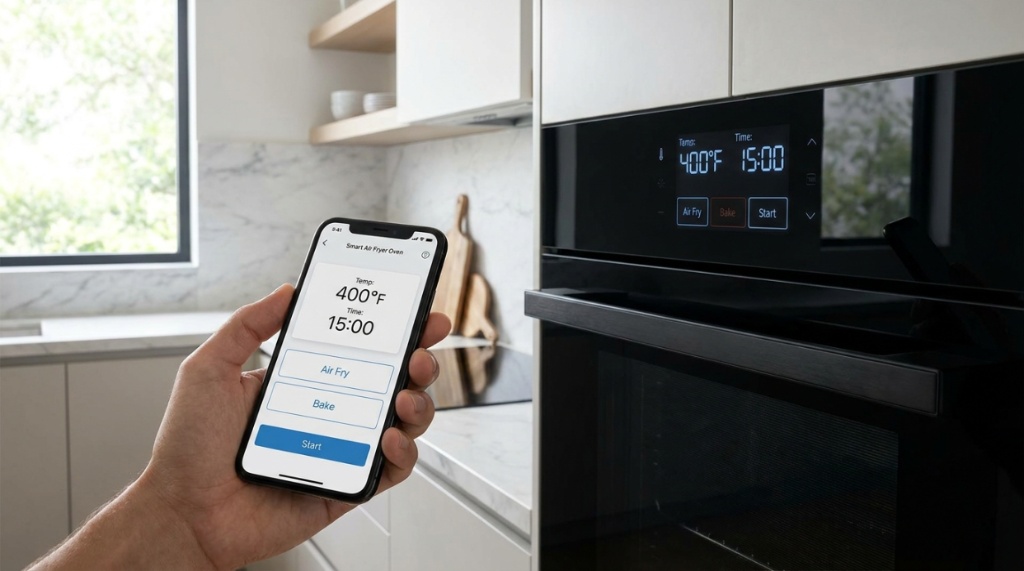
The smart features most valuable for busy families are: remote preheat from phone (start warming while driving home), completion notifications (handle other tasks without watching the oven), one-touch meal presets that children can operate, and voice control for hands-full moments.
Family-specific smart feature value:
- Remote preheat scheduling: Working parents start the oven preheating from the office at 5:30 PM. Arrive home at 5:45 with oven ready. Load prepared food (marinated chicken from fridge). Dinner cooking by 5:50. Family eating by 6:10. Without this feature: arrive home 5:45, start preheat, wait 5 minutes, load food, dinner at 6:20+. Saves 10–15 minutes daily during the most hectic family hour.
- Done notifications: Mom starts dinner, gets notification when food reaches target temperature while she’s helping with homework upstairs. No burned meals because attention was needed elsewhere. No “I forgot I was cooking” incidents that busy family life creates constantly.
- Simple preset interfaces for older children: A teenager loading after-school snacks benefits from one-touch presets (frozen pizza: press button, done). Smart ovens with kid-friendly interfaces let children safely prepare food independently without requiring adult supervision for temperature/time decisions.
- Voice control integration: “Hey Google, preheat oven to 400 degrees” while your hands are full of groceries, children, or cooking prep. Hands-free operation matters most in chaotic family kitchens where both hands are rarely available.
- Multi-step recipe automation: Load a family casserole and select the recipe — the oven automatically bakes at 375°F for 30 minutes, then broils top for 3 minutes, then holds warm until serving. Zero intervention across three cooking stages that would each require manual adjustment in a traditional oven.
How Do You Fit a Family-Size Air Fryer Oven in Your Kitchen?
Family-size air fryer ovens require 22–26 inches of counter width, 16–20 inches of depth, and 4–6 inches of clearance on sides, back, and top for heat ventilation — plan the placement before purchasing to avoid a return forced by space constraints.
Space planning guide:
- Measure first, buy second: Measure your intended counter location including clearance requirements. Total footprint = oven dimensions + 4″ sides + 4″ back + 6″ top. A 20″ wide oven needs 28″ of counter width with clearances. Many buyers discover post-purchase that their “available space” doesn’t accommodate clearance requirements safely.
- Dedicated appliance garage/shelf: Many families install a pull-out shelf or create a dedicated station for the air fryer oven — similar to microwave placement. This solves counter-space concerns while keeping the appliance always accessible at comfortable height.
- Under-cabinet placement: Verify your ceiling clearance above the intended location. Air fryer ovens vent heat upward — insufficient overhead clearance can damage cabinet bottoms, discolor finishes, or create fire hazard from heat accumulation against surfaces.
- Electrical considerations: Family-size models draw 1500–1800 watts. Ensure your intended outlet is on a circuit that can handle this load without tripping breakers — particularly if other appliances share the same circuit. Dedicated 20-amp kitchen circuits are ideal.
Conclusion
A family-size smart air fryer oven transforms daily cooking from a time-consuming obligation into an efficient process that feeds everyone in one cycle without requiring your constant attention. The right model — 26–32 quarts with dual racks, temperature probe, reliable smart connectivity, and construction built for daily use — saves families 5–7 hours weekly through faster cooking, eliminated monitoring, and single-batch meal completion that removes the “cook in batches” frustration of undersized appliances.
Size up beyond minimum. Verify interior dimensions against your actual family meal requirements (12″ pizza, 9×13 dish, whole chicken). Invest $250–$350 for the sweet spot of family features and build quality. Choose brands with proven smart ecosystems (Breville, Ninja, Cosori). And plan your kitchen space before purchasing — because the best family air fryer oven is one that stays permanently on your counter, ready to feed your household at a moment’s notice.
Choosing the right appliance makes it incredibly easy to transition from healthy weeknight dinners to sweet treats without heating up your entire kitchen. Once you find the perfect model with precise temperature controls and multi-tier racks, you can easily bake sweet treats right alongside your main meals. For instance, you can use your new appliance to Make a Delicious Apple Crisp Dessert that comes out perfectly bubbly and golden brown in a fraction of the time a conventional oven would take.
Frequently Asked Questions
Can a smart air fryer oven replace my family’s conventional oven?
For daily meals serving 3–5 people, a 30+ quart smart air fryer oven replaces your conventional oven for 80–90% of cooking tasks. You’ll still need the full-size oven for Thanksgiving turkey, large batch baking (multiple cookie sheets), and oversized dishes. Most families report their conventional oven drops to 2–4 uses per month after adopting a quality family-size air fryer oven for daily cooking.
What’s the best family-size smart air fryer oven under $300?
The Ninja Foodi Smart XL Pro ($250–$300) and Cosori Smart Air Fryer Oven 30L ($200–$250) both deliver excellent family-size capacity with genuine smart features at this budget. Ninja offers maximum versatility (12 cooking functions + probe). Cosori offers the best app experience with VeSync integration. Both handle family meals for 4–5 people comfortably in single cooking cycles.
How loud are family-size air fryer ovens?
Most family-size models operate at 50–65 decibels — comparable to a normal conversation or dishwasher. The convection fan is the noise source. Larger models with more powerful fans (better air frying) tend toward the louder end. If your kitchen opens to living areas where noise matters, check specific model reviews for noise complaints. Most families adapt within days and stop noticing fan sound.
Can children safely use a smart air fryer oven?
Older children (12+) can safely operate smart air fryer ovens using one-touch presets under initial supervision. Cool-touch exterior, auto-shutoff, and child-lock features (available on many models) add safety layers. Young children should never operate the appliance unsupervised. The hot interior and racks create burn risk identical to any oven. Smart features reduce but don’t eliminate the need for age-appropriate supervision.
How often do you need to clean a family-size air fryer oven?
With daily family use: wipe interior after each use (30 seconds), wash racks and crumb tray after every 2–3 uses (dishwasher-safe versions simplify this), and deep clean (interior walls, heating elements, fan area) weekly. Non-stick interior coatings reduce cleaning effort dramatically. Neglecting cleaning allows grease buildup that creates smoke, odors, and eventually fire risk during high-temperature cooking.
Is a bigger air fryer oven always better for families?
Not necessarily. Oversized ovens (36+ quarts) for a 3-person family waste energy heating unnecessary space and consume counter area disproportionate to actual need. Match capacity to your realistic family meal size. A 28-quart oven serving 4 people at 70% capacity performs better (crisper results from proper air circulation) than a 36-quart oven serving 4 people at 45% capacity where excess empty space reduces cooking efficiency.




Leave a Reply