
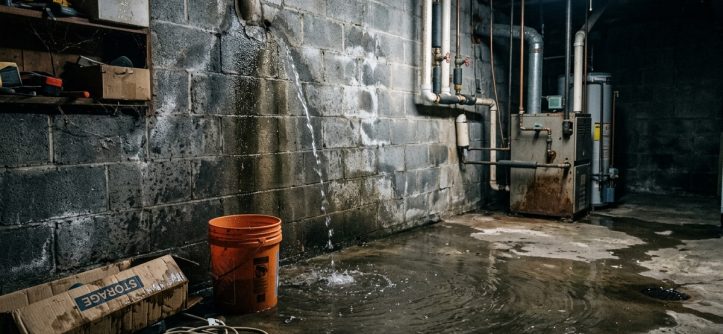
Water moving through a foundation crack rarely follows a simple path. Different resins react in different ways once they enter concrete, masonry, soil, or an active water channel. Understanding how each material behaves helps explain why professional basement leak repair depends on more than filling the opening visible from inside the room.
Polyurethane Foam for Active Water Intrusion
Polyurethane foam is commonly used when water is actively passing through a crack. Contact with moisture causes the resin to expand, helping it travel into narrow voids and irregular pathways that a surface patch cannot reach.
Expansion creates a flexible seal that can tolerate slight movement within the concrete. Contractors often select this material for leaking wall cracks, pipe penetrations, cold joints, and other areas where water pressure may continue after the repair. Anyone searching for basement leak repair near me should ask whether the chosen foam is designed for wet conditions and how the installer controls its expansion.
Flexible Polyurethane Resin for Moving Cracks
Flexible polyurethane resin differs from fast-expanding foam because it forms a more elastic seal inside the opening. That flexibility makes it useful where seasonal soil changes or normal building movement may cause the crack to open and close slightly.
Careful injection allows the material to fill the crack from the inside out rather than covering only its face. Ports placed along the damaged area deliver resin under controlled pressure, while spacing and flow rate help prevent incomplete coverage. This method often suits nonstructural cracks that allow recurring moisture but do not require rigid bonding.
Epoxy Resin for Structural Crack Bonding
Epoxy resin creates a hard bond between separated sections of concrete. Once cured, it can restore strength across a stable, dry crack and help the damaged area act as a continuous structural surface again.
Unlike polyurethane, epoxy has little flexibility after it hardens. Installers usually reserve it for cracks that are no longer moving and are not carrying an active stream of water. A basement leak involving structural displacement may require engineering review before injection begins, since sealing the opening alone will not correct settlement or wall movement.
Hydrophobic Resin for Persistent Seepage
Hydrophobic resins repel water after curing, making them useful where groundwater repeatedly reaches a foundation. These materials react with a controlled amount of moisture but do not absorb much water once the seal forms.
Lower water absorption can improve durability in areas exposed to ongoing dampness. Technicians may inject hydrophobic polyurethane into wall cracks, joints, or voids where the surrounding material stays wet for long periods. Resin selection still depends on temperature, crack width, reaction time, and the pressure behind the leak.
Hydrophilic Resin for Wet Concrete Voids
Hydrophilic resin attracts and mixes with water during its reaction. That property allows it to follow moisture into fine cracks, porous concrete, and small spaces that may be difficult to fill with thicker materials.
Because this resin can absorb water, it may remain soft or gel-like after curing. Contractors often use it for low-pressure seepage, construction joints, and damp masonry rather than high-movement structural damage. Proper formulation matters because too much water exposure can affect the finished material’s size and long-term performance.
Acrylic Gel for Fine Cracks and Masonry Joints
Acrylic gel has a very low viscosity, often close to the consistency of water. Its thin form allows it to enter hairline cracks, mortar joints, and tiny capillary spaces that standard injection foam may not penetrate fully.
Fast or adjustable reaction times give installers control over how far the gel travels before it sets. Crews may use acrylic systems behind foundation walls, around joints, or within porous masonry to create a moisture barrier. Specialized pumps and precise mixing are usually required because small changes in the formula can alter curing speed.
Epoxy-acrylate Resin for Added Strength and Adhesion
Epoxy-acrylate resin combines strong adhesion with faster curing than many traditional epoxies. The material bonds well to concrete and masonry while offering more tolerance for field conditions than some rigid structural products.
Applications may include dry or slightly damp cracks that need both sealing and added strength. However, active water flow can interfere with bonding unless the opening is controlled first. Professionals may stop the water with polyurethane, then use a stronger resin where structural reinforcement is also needed.
Silicate-based Resin for Soil and Void Stabilization
Silicate-based injection materials can strengthen loose soil and fill small voids outside the foundation. Their low viscosity allows the liquid to move through fine spaces before hardening into a more stable mass.
Soil treatment may support basement leak repair when erosion, washout, or underground water movement has created channels beside the wall. Injection locations, volume, and pressure must be planned carefully to avoid pushing material into drains or unwanted areas. This approach controls the surrounding conditions rather than simply sealing an interior crack.
Cementitious Microfine Grout for Larger Gaps
Microfine cement grout contains smaller particles than ordinary cement mixes, allowing it to enter tighter spaces while curing into a rigid mineral-based fill. Contractors may use it for larger cracks, masonry voids, deteriorated mortar joints, and gaps where flexible resin would not provide enough body.
Mineral grout handles compression well but does not stretch with moving concrete. Successful placement depends on proper water ratios, pump pressure, and surface preparation. Deep voids may require staged injection so the material fills evenly without trapping empty pockets.
Choosing Resin Based on the Leak, Not the Label
Material names alone do not determine whether a repair will last. Crack movement, wall thickness, water pressure, moisture level, concrete condition, and access all affect which resin can reach the source and remain stable.
Accurate diagnosis also helps reveal whether the basement leak comes from a single crack or a larger drainage problem. Kennedy and Sons evaluates foundation openings, wall joints, groundwater pathways, and related structural concerns before selecting an injection method. Their team can develop a basement leak repair plan that matches the resin to the actual conditions rather than relying on one product for every type of water intrusion.


Leave a Reply